Men's Leather Sandals Wholesale: A Buyer's Guide
What separates a leather sandal worth stocking from one that comes back — construction, colour, sizing, and when to place the order. Featuring the YKT09 in black and brown.
By Hector Footwear Team · 6 September 2026 · Updated 24 September 2026 · 5 min read
Also available in: Ελληνικά
Sandals are the shortest selling window in a men's footwear range and the least forgiving. A boot that does not move in November can still move in January. A sandal that is not on the shelf in May has missed its year.
They are also the category where quality shows fastest. There is no upper to hide behind — a customer sees the straps, the footbed and the sole, holds the shoe, and decides within seconds. This guide covers what to look for when buying men's leather sandals wholesale, and what we make.
Our sandal range
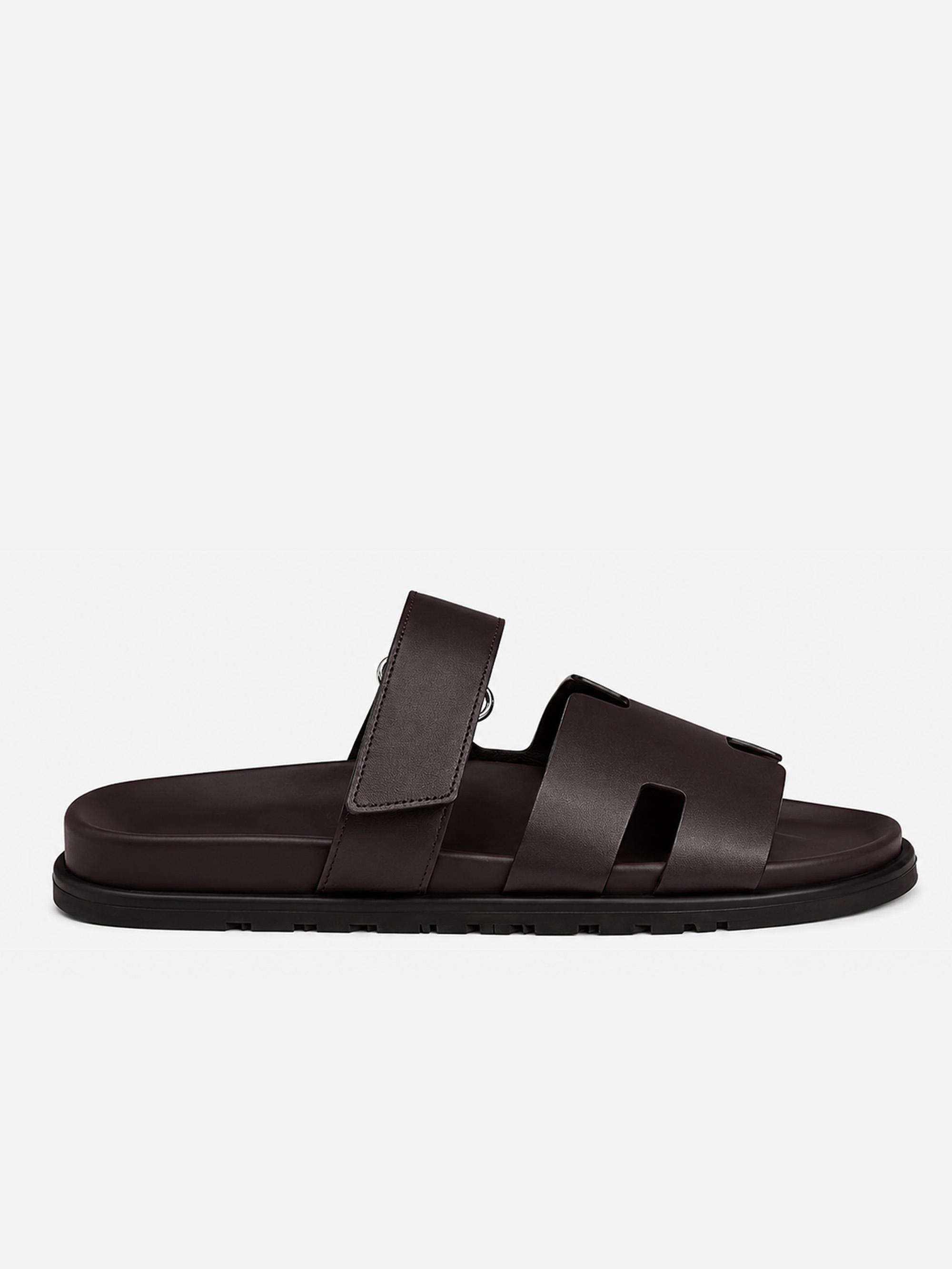
Our sandal range is deliberately narrow: one last, two colours. The YKT09 Black and the YKT09 Brown are men's genuine leather sandals with adjustable fastening and a contoured, arch-supporting footbed, on a slip-resistant outsole.
Two colours in one shape is a deliberate choice rather than a limitation. Sandals are bought on fit and comfort far more than on styling, so range depth in this category tends to produce leftovers rather than sales.
What to look for in a wholesale leather sandal
Four things decide whether a leather sandal is a repeat line or a markdown.
- Genuine leather straps, not bonded. Real leather softens and moulds to the foot over the first week, which is why a good leather sandal gets more comfortable rather than less. Bonded and coated materials do the opposite — they crack where they flex, and on a sandal every strap is a flex point.
- A contoured footbed. Flat footbeds are cheaper, and they are a common reason a sandal is worn twice and then abandoned. Arch support is what makes a sandal wearable for a full day rather than for a walk to the beach.
- A slip-resistant outsole. Sandals are worn on wet tile, pool surrounds and boat decks. This is a safety property, not a specification detail.
- Adjustable fastening. The most underrated feature in the category, and the one with a direct commercial effect — see sizing below.
Black or brown: which to stock
If you carry one colour, carry black. It is the easiest sandal colour to sell because it needs no thought from the customer and reads correctly with everything.
If you carry two, brown earns its place for a different reason: it styles more easily. Brown works with shorts, with linen and with chinos, and it does not read as a beach sandal when it is worn in town. That is the customer who buys a leather sandal rather than a rubber one, and brown is the colour that customer usually wants.
Sizing, and why adjustable fastening matters commercially
When a sandal comes back, it is usually because of size. A closed shoe holds the foot and forgives half a size; an open sandal shows every millimetre of overhang and does not.
Adjustable fastening absorbs that. A customer between sizes can make either work, which converts a fitting that would have ended in no sale — or in a return two weeks later — into a sale that stays sold. When you are comparing sandals from two suppliers on paper, this is the specification worth weighting most heavily.
How the boxes work
We sell by the box, never by the pair, and every style has one fixed box format rather than a choice of them. For the sandals that is the 10-pair box, in a fixed run:
- EU 40 × 1
- EU 41 × 2
- EU 42 × 2
- EU 43 × 2
- EU 44 × 2
- EU 45 × 1
That distribution reflects real demand rather than an even split: 41 to 44 carry the sales, 40 and 45 are the edges. One box per colour — twenty pairs across two colours — is a complete sandal offer for most independent stores.
When to order
Both sandals are pre-order styles, produced against confirmed orders rather than pulled from a shelf. That makes timing the single most important decision in this category.
Demand peaks between June and August, and it is sharpest in tourist areas — a coastal or island store can sell through a season's sandals within a few weeks. Because production runs against your order, a sandal buy placed in spring arrives for that window. A sandal buy placed in June arrives for the end of it.
Common questions
Do you sell leather sandals in single pairs? No. We are wholesale only, and the ordering unit is the 10-pair box.
Are the sandals men's only? Yes — the YKT09 is a men's last in EU 40–45. If you need a unisex option for the same season, the 692 loafer is cut for both.
Can I mix colours in one box? No. A box is one style in one colour. Two colours means two boxes.
Will two pairs look identical? Not exactly. Leather is a natural material and grain and colour vary between hides and between production runs; this is normal and is not a defect. If you are building a display, order the colour in one go rather than across two seasons.
Who makes them? We do. Hector Footwear has made men's leather footwear since 1984. We are based in Heraklion, Crete, and sell to the trade only — there is no direct-to-consumer shop undercutting your prices.
Ordering
Wholesale prices are shown once your trade account is approved and you are signed in. Accounts are approved for prepayment, net 30 or net 60, with the discount decreasing as the terms lengthen.
See both sandals in our sandals collection, or apply for a wholesale account — applications are reviewed by a person, usually within two business days.
Ready to source from Hector Footwear?
Browse the collection or apply for a wholesale account.